EDITORIAL
September…
We are no experts here in astrology, much less in weather and climate reading. Keen observers might be. Now we see a September month evolving to be a “harsher” period of the year in recent memory as in 2009 and this year, 2011.
A gentler month of old, September ushers in the days of “ber” when we start to feel the cool caress of “hanging amihan” [northeasterly breeze] which, in turn, signals the coming of Christmas alongside the blissful rice harvest season.
A record five typhoons lashed at our shores September 2009. Same month this year whipped up three. Both instances hit most of Luzon setting equally record high tens of billions worth in damages to property, business, animal lives and agriculture. More than a thousand people died of various circumstances including from a rat-caused disease, leptospyrosis, otherwise unheard of in yesteryears’ typhoon disasters.
Disturbing signals were seen here. First, September was more of a typhoon-less month a decade or so ago. The period June-July was it, as in the 64-day deluge of 1972. Second, weather disturbances then were not as “wet” [heavy rainfall] and “harsh” [packed up speed/strength] as they are now. Third, they come close of each other as in September 2009 that hosted a record five, with the last two—typhoons Ondoy and Pepeng—ravaging the National Capital Region [NCR, or Metro-Manila], most of Central and North Luzon, and the Southern Tagalog Region [or Calabarzon area]. Fourth, prolonged summer cum drought and hotter days. Fifth, but not so much seen nor felt yet, is the rising world sea level. Lastly, the remarkable spread of strange illnesses such as the deadly rat-caused disease called leptospyrosis during typhoon days victimizing both urban and rural communities.
Experts and scientists are one in claiming that drastic environmental changes in the past 60 years brought forth the root-cause of all these disasters—climate change. Meantime, this “environmental aberration” will be a lengthy discourse for an editorial. ANL do know that climate change, or global warming, is ultimately a man-made disaster itself. rmb
FEATURE
Climate change, rats, drought, our hometown Asingan, etc..
by: ruben m. balino
Climate change, per se, could not have gone awry. Defined as the overall heating up—if not cooling down—of global temperature. Nice imagining if it cools down back to what it was a hundred years ago, or if mankind could have maintained it that way.
But that was wishful thinking. So bad it heated up enormously during the same period that humans need no statistics to physically feel it so. Peak of summer now fetches up a feverish range of 37-40 degrees in some parts of the country. Tuguegarao City in Cagayan picks up almost 40 in 1990. Prolonged summer that year wilted down thousands of hectares of cornfields in the entire Cagayan valley worth billions of pesos.
 Climate change [CCh] is now simply equated to global warming [GW]. Overall global sea level has been observed by scientists to have risen 40 centimeters in the last century or so due to melting down of polar ice caps both in the Arctic and Antarctic regions caused by global heat-up, endangering low-lying islets and island-nations to being submerged underwater, or disappear altogether. Manila Bay which overflowed during typhoon Pedring late September was reported to have upped 0.8 meter during the last 100 years.
What then are the aggravating factors to global warming, or climate change? Scientific studies and matter-of-factly observations point at man himself as the one major factor to this climatic debacle. Man’s greed for huge profit plus his ambitious urge for high-end technology and unhampered development. Man’s feverish activities like deforestation, pollution, destructive mining and fishing, irreverent waste disposal system, irresponsible land use conversion schemes, ineptness in urban planning, were a cause for worry.
Way back home in Asingan, Pangasinan [together with the many towns along the huge Agno River], flooding and erosion of farmlands were unsolved problems in the last 50 years. The engineering booboos of building uncemented dike where the river flow goes—or a method termed “salsalikbay” in Ilokano—was a proven nonsense in decades and yet government repeatedly go for it at the expense of people’s money as the fragile dike burst out almost yearly. Redirecting the river’s flow to its original track by bulldozing it deep down when it was still a small and manageable river system could have been the most practical and less expensive method. Aside from vanishing croplands, siltation and pollution problems bedevil the once pristine Lingayen Gulf where Agno River ends and pours down its cascading waters, plus the silt, during typhoons.
Flooding in the central plains of Luzon including Pangasinan flashed out rats spreading the deadly disease called “leptospyrosis” caused by the poisonous urine of these pernicious little mammals mixed up with floodwaters.
The once equally-spread months of dry and wet seasons is a thing of the past. Although typhoons nowadays are remarkably stronger and bring heavier rainfall [La Nina phenomenon], a pronouncedly dry and prolonged summer period [El Nino phenomenon] confounds drought pestering agriculture which hardly had bounced back from yearly devastating typhoons.
The irony of it all for Pangasinenses was that the Agno River Basin is rendered waterless during summer for years now since the completion and operation of the gigantic San Roque Dam. Say dam officials, closing the dam’s spillways on summer is aimed at collecting and holding enough water to a level capable of generating electricity. Conspicuously though, this is depriving farmers of irrigation water on a period when it is most needed.
Finally, two ultimate questions come to fore, namely: What heats up the globe? And how?
Man’s feverish acts boil down to unabated degradation and pollution of the earth’s surface [overland], the water bodies [water pollution], and the atmosphere [air pollution] caused by pollutant gases known as GHG’s [greenhouse gases] accumulating and hanging unto the earth’s atmosphere enveloping the globe whilst trapping heat upping global temperature. These GHG’s likewise trap heat from the sun never allowing the same to escape out high above the earth’s surface thus aggravating global warming even more.
The one last major frontier to sap out heat—the world’s forests—is fast vanishing. The “green mantle” of planet earth—the trees, bushes, grasses—were undermined of their soothing color; of their being actors in the manufacture of the water we drink and the oxygen we breath; of their holding capacity to store water in their whole system; of their defensive strength and power as windbreaks and erosion control for their root system; and of their breezy cool shades yonder.
Back to man himself. He poorly lacks appreciation of nature. And he never learns. There lies the deadly prospect of what is to come for mankind!
N E W S
Asingan reels from low-altitude typhoon winds
by: joe l. sevilla
Lucky enough most of Asingan and surrounding towns of Pangasinan reaped their rice produce earlier than the coming of the September “blockbusters”. Most people have yet to plant vegetables while other rice farmers were yet tending young rice paddies strong enough for the rains and typhoon winds.
Moreover, the rains were less heavy than the deluge brought about by typhoons Ondoy and Pepeng of September 2009. This time, the gigantic San Roque Dam didn’t release much water to save face as they did during Pepeng’s onslaught where everything was so sudden, unannounced, less gradual ant therefore utterly irrational.
Still, Asingan and the eastern half of Pangasinan reeled from relatively strong but low-altitude winds which all the more made it destructive as it creep down to obliterate even low bushy-type trees, backyard plants, existing farm vegetables and ripening rice farms.
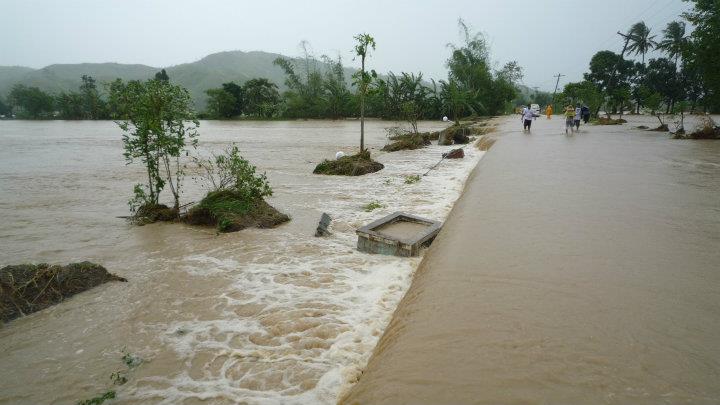
On the whole, September this year still is a dampening month whipping up three typhoons, the last two—Pedring and Quiel—swept the provinces of Isabela and Cagayan of Region 2; Aurora Province along the Pacific coast; the provinces of Pampanga and Bulacan in Region 3 [Central Luzon area]; and Pangasinan in Reion 1.
Damages cost about 15 billion pesos and more than 40 dead. Most of Metro-Manila were afloat for days causing work and class stoppages, traffic jams, power and water outages, garbage uncollected or strewn all over. Sad and ironic for a resource and piety-rich nation to face all these woes when the goings get rough.
LITERARY
irony at its cruelest!
scribbled by: ruben m. balino
[while browsing the net…]
cyber age yet have seen
unclothed, shrunken dead
innocents in corners of the globe
deprived of food
of love
of care
nay pity…
[mother earth still aplenty
of wealth but much of her
children lay abandoned
and strewn on the dirt!]
at reality’s bitter end
cabal of multi-billionaires
feed their huge bounties
to the burgeoning stomachs
of giant transnational banks!
should we moderate our greed
nipping the hunger of others
as the souls in skin and bones
young, languishing souls
feed unto the fangs
of inequity
of irony
at its cruelest!
 In sum, typhoon months of yore were mainly June-July. Today, it drastically moved to September-October courtesy of climate change. And yes, the archipelago have had enough plant and forest cover then to shield the country from extreme conditions of both dry and wet seasons. Now, severe flooding and prolonged drought were largely unchecked by any serious adaptation or mitigation strategies simply because of government ineptness, lack of funds, and technological inadequacy. Disaster preparedness and public awareness are wanting, too.
  Apparently, “undas” is closely associated with the Spanish word andas, or possibly honra, meaning Day of the Dead (“Araw ng Patay”). Curiously though, undas is being observed in the Christian world in various ways and dates, in which case a more scholarly and lengthy discourse necessitates a separate article on the matter.
  Yet, the undas of old—for the likes of Asinganians still commemorating in the traditional manner like the “Atang” (food offering) and the “Tugkel Kandila” (candle lighting) both done at home and in the cemetery—is here to stay solemn for some time and dwell in our rural psyche, uniting families and friends and bonding old relationships stronger as ever. Hoping, as it should, a remarkably rich Pinoy tradition like the undas must be enshrined into our conscious and disciplined mind to become a stronger cultural fiber that holds us together to one solid nation now and into the future.